
Bringing the Environmental Conventions Index to the Table at UNEA-7

Diane Grant, former Masters of Engineering and Public Policy student, working at the intersection of the environment, emerging technology, and policy with a focus on community-centered approaches and environmental justice.
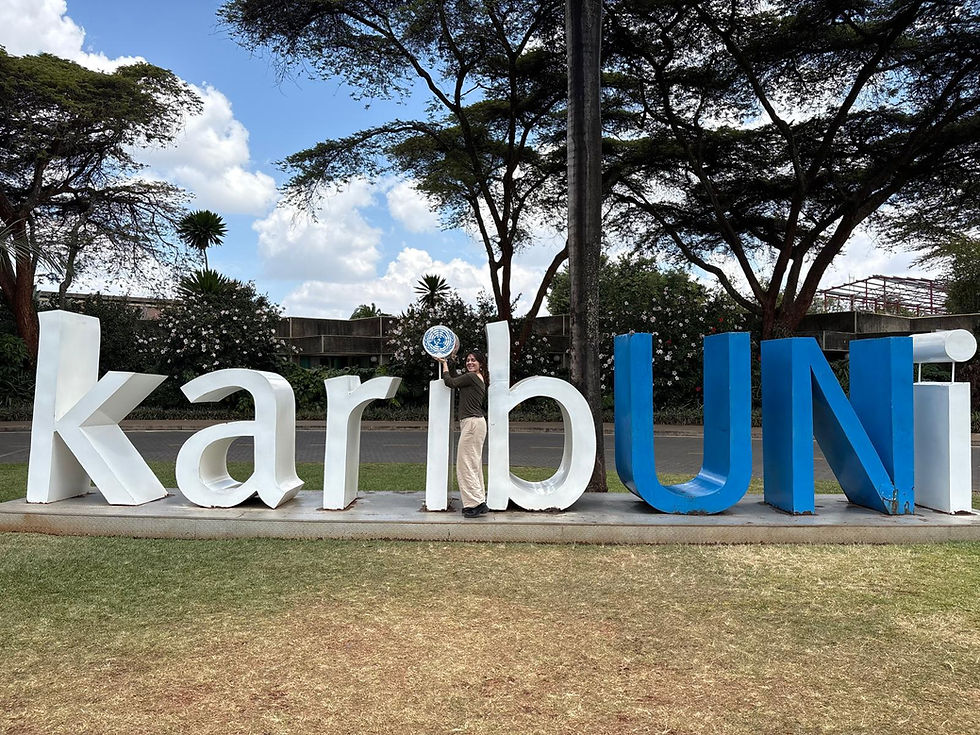
As a newly inducted graduate student in the Engineering and Public Policy PlusOne program, I was excited to explore new opportunities at the intersection of my interests in tech, sustainability, and policy. I soon got the chance when I met Professor Ivanova at the welcome event for all new public policy students in September 2025. In a few weeks, I started working on the Environmental Conventions Index (ECI) improving documentation and technical processes related to the website and data processing. I added accessibility improvements, published updated data for conventions, and compiled preliminary data that was shared at the December 2025 United Nations Environmental Assembly (UNEA). As a part of the project, I was funded by the Public Policy School to travel to Nairobi for UNEA. The experience was incredible. Up until this point, I was focused on local policy and had no exposure to international environmental policy spaces. With the support of Maria and the PhD students working on these issues, I quickly learned all about the United Nations Environmental Program (UNEP) and the governance negotiations that would take place.
A major focus of UNEA 2025 was on strengthening synergies and support across Multilateral Environmental Agreement (MEA) implementation. The ECI does exactly that, measuring national reports across four major conventions, identifying key reported implementations of the treaties. At the conference, I went from side-event to event listening to the priorities and needs of countries and UN entities as related to MEAs. After each event I approached or was approached by people interested in how the ECI could support their work. In these conversations, I showcased the ECI data, allowing delegates to explore their country’s performance across categories, over time, and compared to regional partners. In between these interactions I prepared graphics and researched countries backgrounds to have richer conversations with the delegates. Our team spoke with multiple countries and leaders invested in our work. I will never forget the moment when a member of the Zimbabwe delegation approached me to ask about their country’s data. After some discussions and data-sharing our interactions culminated in Zimbabwe’s Minister of Environment highlighting our work in statements at the MEA Day Reception.
The momentum built for the ECI at UNEA was powerful. Starting the new semester in January, I was filled with ideas and passion for how to best utilize and expand the ECI. While there are technical improvements to be made, UNEA sparked great opportunities for creative and collaborative projects. Presenting data in exciting and more impactful ways, facilitating peer-to-peer conversations within regions, and telling the stories behind MEA implementation are all future paths to this work inspired by UNEA.


Comments